


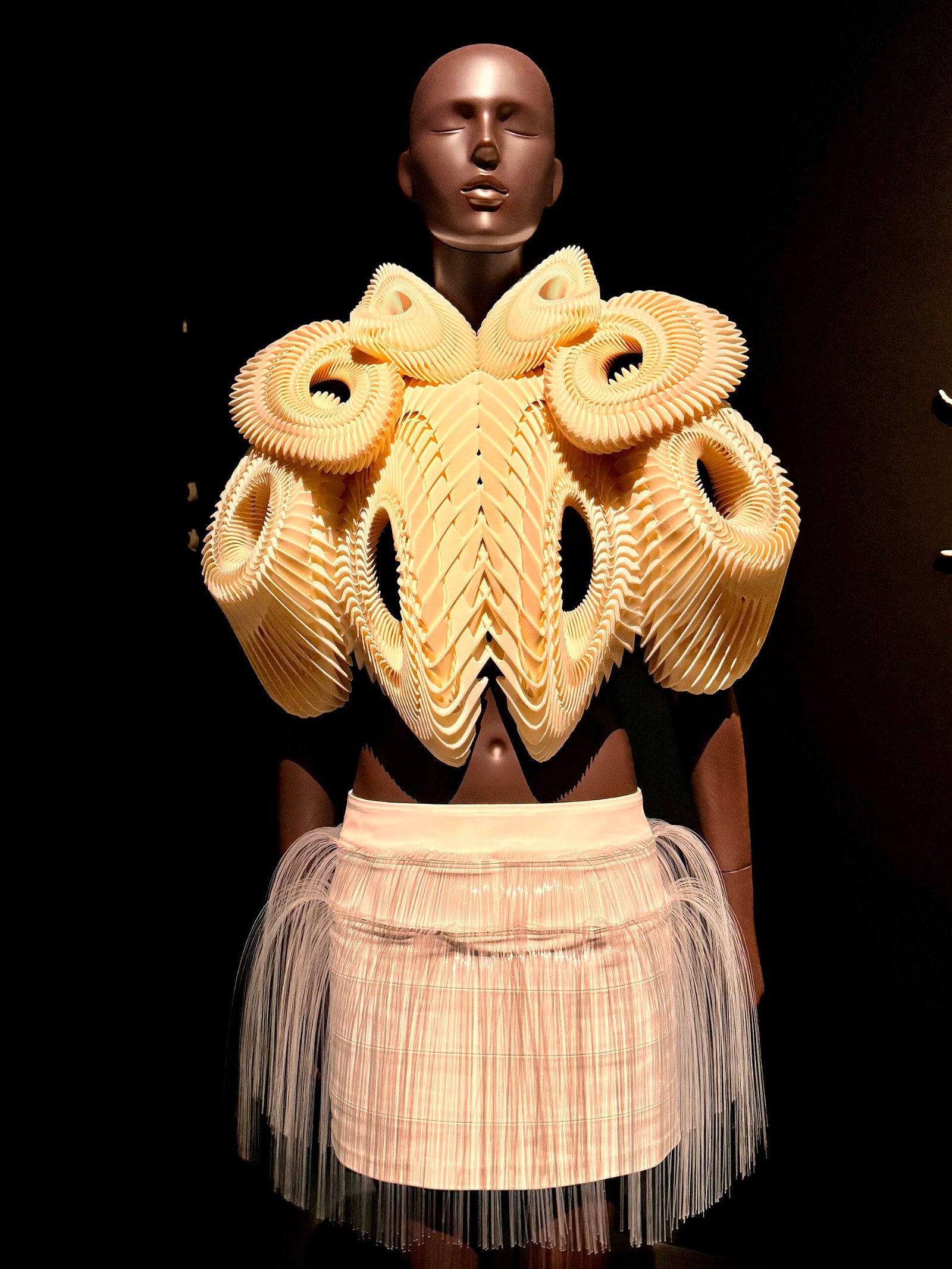
Dutch designer Iris van Herpen has turned her retrospective into an unusual experiment. The exhibition is running at the Brooklyn Museum in New York. At the centre of Iris van Herpen: Sculpting the Senses sits a workshop. Visitors sit down opposite the designer and pleat fabric. The resulting pieces form the train of a new haute couture gown. FashionUnited published a report on 2 November based on AFP. According to the report, around 200 people have taken part in the process since the summer.
When the atelier comes to the museum
Haute couture is usually born behind closed doors. It emerges from months of handwork. The audience only sees the result, the piece on the runway or in the window. This time, however, Van Herpen is exhibiting the process itself. According to Hyperallergic, the workshop is a working space recreated at the heart of the exhibition. The publication describes it as the first of its kind for the museum. RetailBoss also writes that the designer has been welcoming visitors at set intervals throughout the exhibition. These encounters take place in the museum’s central rotunda, at a table evoking her atelier in Amsterdam.
The designer told Hyperallergic that she wanted to share her craft in an intimate setting. Craft, she says, is the most beautiful part of her work. She described her atelier as her most sacred space. The same article also quotes her likening hands to a language: “Hands are like a language”.
How the Airo gown comes to life
According to FashionUnited’s report, the piece the team is working on is the mermaid-silhouette Airo gown. The gown has demanded hundreds of hours of work. Visitors sit opposite van Herpen for around ten minutes. They pleat a thick, silver-toned silk fabric. At the same time, they chat with the designer. The pieces are added to the gown’s train. In the report’s comparison, a sculptural texture emerges that recalls frozen sea foam, lava flows and climbing ferns.
The conversations serve a purpose too. The designer asks participants to share a memory. It might be a moment when they connected with nature, or the sense they consider most important in their relationship with the world. The conversations are then recorded. The team says the most memorable ones will be embroidered on the inside of the gown. Van Herpen says she sees this as a kind of time capsule for the exhibition: “It also allows me to create a sort of time capsule of the exhibition,” The designer adds that she is curious about whom she will meet. According to Hyperallergic, every pair of hands that joins van Herpen influences the gown’s DNA.
According to the report, participants include artists, scientists, lawyers and journalists. For example, 48-year-old lawyer Shannon Green said she had never worked on a haute couture gown before.
What’s in the exhibition?
Sculpting the Senses is the first North American stop of the touring retrospective that set out from Paris. Opened on 16 May 2026, the selection features more than 140 haute couture designs. Alongside the designs are contemporary art, design and scientific objects. According to The Untitled Magazine, the exhibition follows a thematic route stretching from the depths of the ocean to the far reaches of the universe. The route runs from a section that treats water as both material and metaphor to skeletal architecture. It also covers themes from the physics of movement to the perception of sound and light. The exhibition is accompanied by a sound design by Dutch composer Salvador Breed.
Time Out writes that the Hydromedusa dress from the 2020 Sensory Seas collection is on display. Also there is a 2025 “living look” containing bioluminescent algae, developed with biodesigner Chris Bellamy. The exhibition previously opened at the Musée des Arts Décoratifs in Paris. It then travelled to Rotterdam, Singapore and Brisbane.
A small note for those planning a visit: the announcement gave the closing date as 6 December 2026. FashionUnited and Time Out, however, report that the exhibition will remain open until 3 January 2027. It is therefore best to check the museum’s official website for up-to-date information.
Why it matters
Fashion exhibitions usually show finished pieces behind glass. Van Herpen’s experiment, by contrast, lets the audience experience the true value of haute couture first-hand. That value lies in handwork, time and collaboration. It is also striking that a designer known for science and technology is putting one of the oldest techniques, pleating, in the spotlight.
Seen from Turkey, this model is inspiring for fashion education and museum practice. An exhibition that reveals the atelier process serves as a lesson for young designers and aspiring professionals. You can follow the season’s key fashion events in our Fashion Week Calendar 2026–2027 guide.
Iris van Herpen and the invisible labour of couture
Haute couture means high fashion bound by specific rules in Paris. Every piece is made by hand and to measure. A single gown can require hundreds of hours of atelier work. Yet this process almost never takes place before the audience’s eyes. Iris van Herpen’s workshop at the museum stands out precisely because it turns this invisible labour into an exhibition.
For another example of fashion meeting the museum, see our report on Dice Kayek’s design in the V&A exhibition. For general information on the designer’s career and her relationship with technology, see the Iris van Herpen entry on Wikipedia.
Sources
- FashionUnited — Iris van Herpen’s participatory workshop in New York (AFP)
- Hyperallergic — Pleating With Iris van Herpen
- RetailBoss — A new couture piece made with visitors at the Brooklyn Museum
- Time Out New York — Brooklyn Museum fashion exhibition
- The Untitled Magazine — Sculpting the Senses in Brooklyn
Image: An Iris van Herpen design shown at the 2024 Brisbane (QAGOMA) stop of the Sculpting the Senses exhibition (representative image; not from the Brooklyn exhibition) — Kgbo, Wikimedia Commons, CC BY-SA 4.0
