


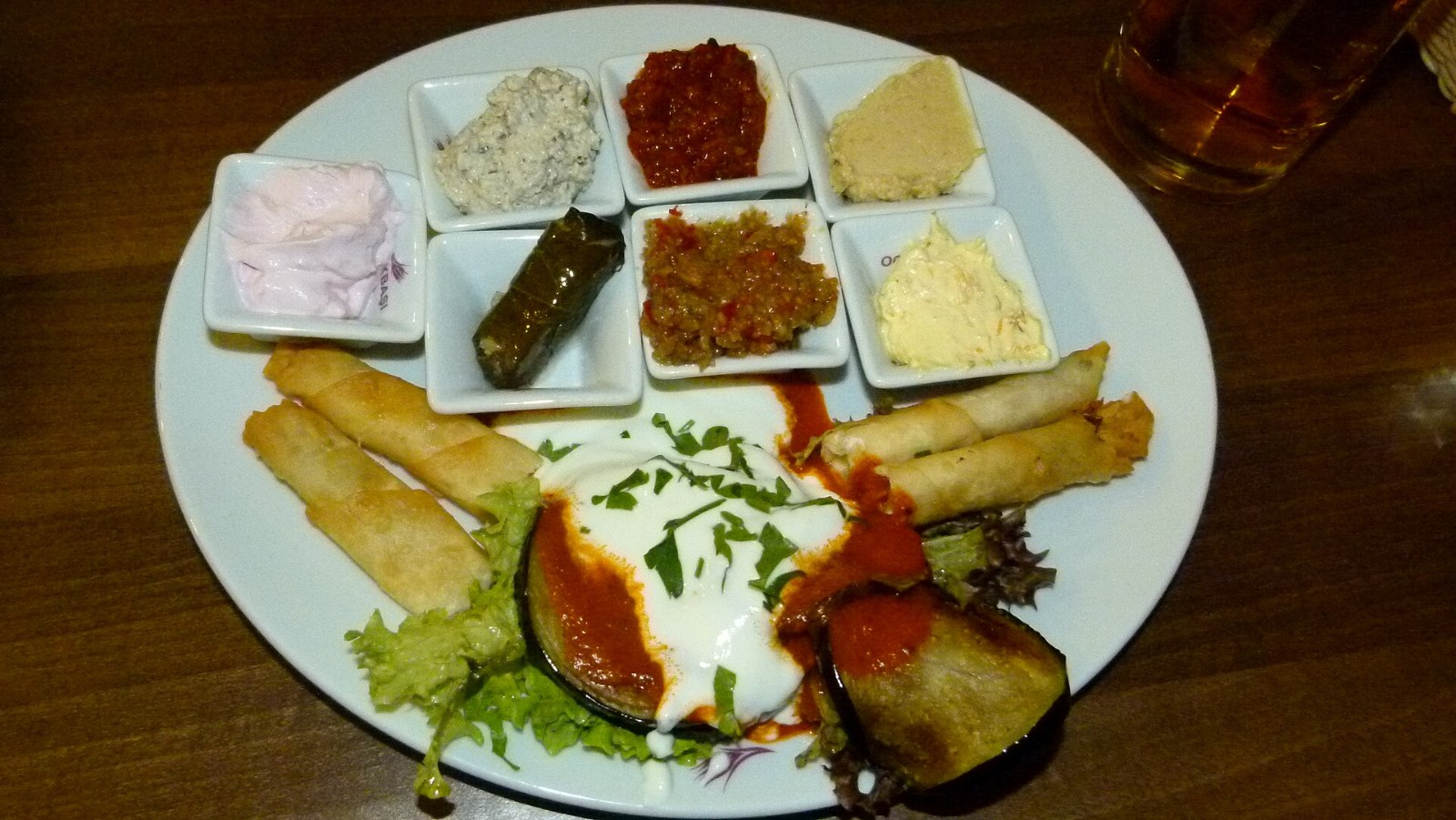
Turkish cuisine is the sum of a rich heritage stretching from the Ottoman table to the present day, and of flavours that change from region to region. We wrote the rest of this article in English.
Turkish cuisine is largely the continuation of Ottoman cuisine. This cuisine in turn borrowed many elements. They came from Central Asian, Caucasian, Middle Eastern and Balkan cuisines. Turkish cuisine has in turn influenced those and other neighbouring cuisines.
Its features include spices. Traditional Turkic elements from Central Asia, such as yogurt and manti, are also part of it. Its features also include a preference for rice over bulgur and koftes. Moreover, vegetable stews, eggplant, stuffed dolmas and fish are widely available.
The Black Sea Region uses fish extensively, especially the Black Sea anchovy (hamsi). It also includes maize dishes. The southeast (for example Urfa, Gaziantep, and Adana) is famous for kebabs and mezes. It is also famous for dough-based desserts such as baklava, sobiyet, kadayif, and kunefe.
Olive oil is the major oil for cooking. The cuisines of the Aegean, Marmara and Mediterranean regions are rich in vegetables, herbs, and fish. Central Anatolia also has many famous specialties. Examples are keskek, manti (especially from Kayseri) and gozleme.
Urfa kebap and Adana kebap differ in two ways. One is the thickness of the skewer. The other is the amount of hot pepper. So Urfa kebap is less spicy and thicker than Adana kebap.
Meat-based foods such as kebabs are the mainstay of Turkish cuisine in foreign countries. However, native Turkish meals largely center around rice, vegetables, and bread. freshmodelsmagazin.com has new tag: Turkish Cuisine recipes.
Enjoy! delightfully Turkish Cuisine recipes in your kitchen….
Turkish cuisine by region: a short summary
On the Black Sea coast, fish, especially anchovies (hamsi), and dishes made with cornmeal sit at the heart of the table. The Southeast, home to Urfa, Gaziantep and Adana, is known for its kebabs and mezes, and its dough-based desserts such as baklava, künefe and kadayıf are famous too. In the Aegean, Marmara and Mediterranean regions, vegetables, herbs and fish predominate, and olive oil is the most widely used cooking fat.
Central Anatolia, meanwhile, stands out for dishes such as keşkek, mantı and gözleme. As the article reminds us, everyday meals cooked at home mostly do not contain meat; instead, rice, vegetables and bread take centre stage.
For more on the history and regional diversity of Turkish cuisine, see the Turkish cuisine entry on Wikipedia (Turkish). For a practical recipe from our food section, try our vegetable noodle recipe.
Image: A mixed Turkish meze platter: haydari, ezme, hummus, stuffed vine leaves, sigara böreği and yoghurt on roasted aubergine. — Dr. Bernd Gross, Wikimedia Commons, CC BY-SA 3.0